Positive Pressure vs Positive Pressure + Decentralised Extraction
Which approach is better for a New Zealand home? The answer isn't simply about pushing air in or pulling air out. Fresh-air source, moisture extraction, airtightness, airflow paths and system design all matter.
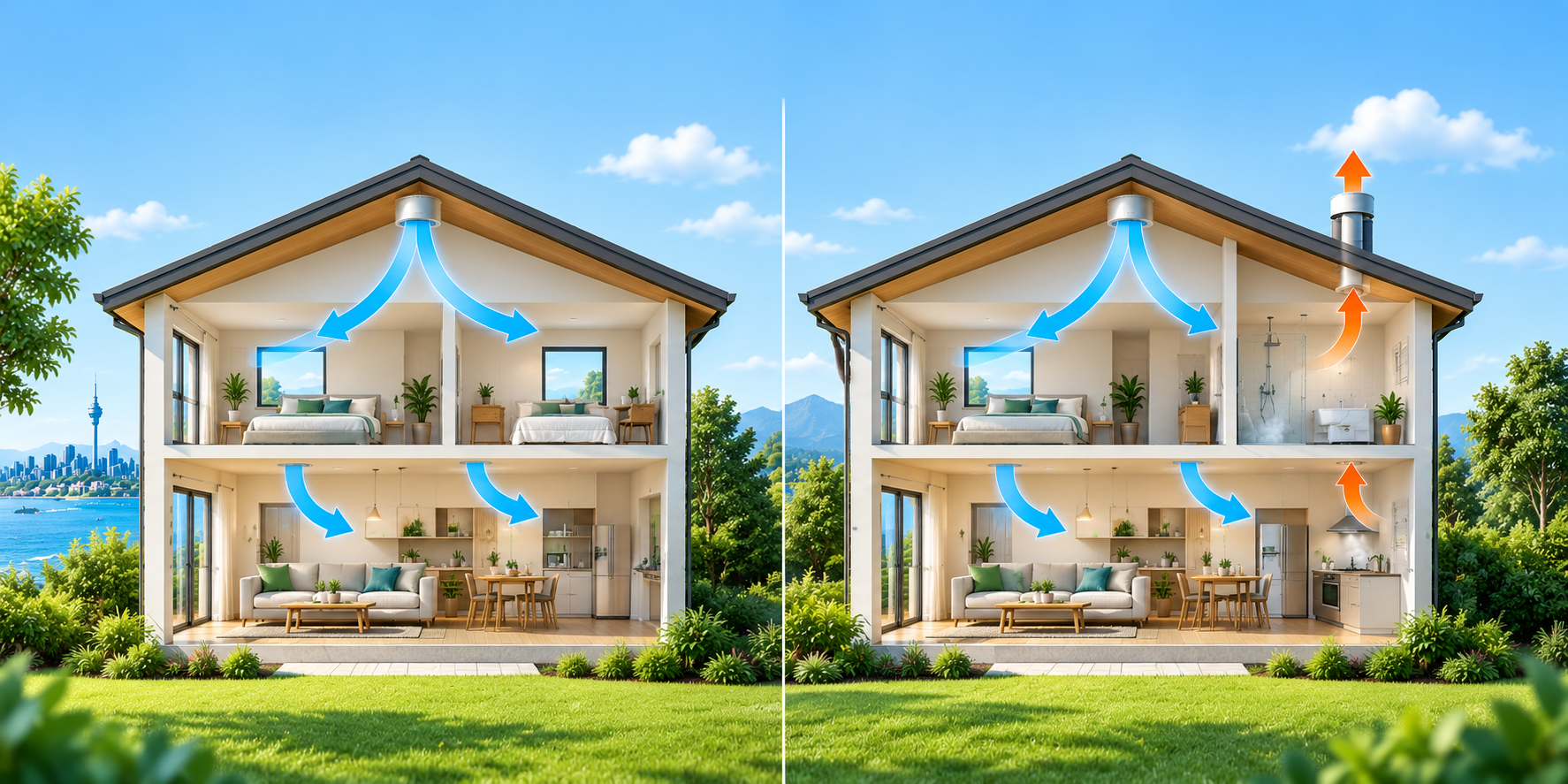
Blue arrows show fresh-air supply. Orange arrows show local extraction.
The quick answer
Can be practical when the home and system are suited to it.
Adds dedicated local extraction to remove stale, humid air at source.
Is a separate technology and should not be used as another name for balanced ventilation.
Depends on the building, moisture loads, airflow needs and installation.
First, what do these two approaches actually mean?
Ventilation is the controlled movement of air into and out of a home. The aim is to bring in suitable outdoor air while removing moisture, pollutants and stale air.
Positive pressure ventilation
A positive-pressure system mechanically supplies air into the home. The incoming air increases the pressure inside the building slightly, encouraging air to leave through gaps, openings and other available leakage paths.
Positive-pressure systems are common in New Zealand. Their performance depends on factors including fan sizing, supply distribution, the home's airtightness and the source and quality of incoming air.
Positive pressure + decentralised extraction
This approach keeps the positive-pressure supply principle, but adds dedicated extraction at selected rooms or moisture sources. The house is still supplied with air under positive pressure, while local extract fans actively remove stale or humid air.
This is not the same thing as balanced ventilation. The objective is not to balance supply and extract airflow across the whole house, but to improve control of where moisture and stale air are removed.
Why we avoid calling this “balanced ventilation”
This distinction is important when comparing systems.
These terms are often confused. For this guide, we are deliberately comparing positive pressure with positive pressure plus decentralised extraction. This makes the airflow strategy clearer and avoids implying that every system with mechanical extraction is a heat-recovery system.
What actually makes the difference?
Rather than comparing labels alone, look at what the system is doing inside the home.
| Consideration | Positive pressure | Positive pressure + decentralised extraction |
|---|---|---|
| Fresh-air supply | Mechanical supply into the home. | Mechanical supply to selected areas. |
| Stale / moist air removal | Air leaves through available leakage paths and openings. | Local extract fans provide deliberate removal from selected rooms or moisture sources. |
| Airflow path | Depends more heavily on the building and available pathways. | Supply locations and local extraction points can be deliberately positioned to improve airflow through the home. |
| Fresh-air source | Depends on the particular system; the source should be understood. | Normally designed around outdoor air supply. |
| Airtight homes | Performance needs careful consideration because there may be fewer pathways for supplied air to leave. | Local extraction gives stale and humid air a defined exit, but the overall positive-pressure strategy still needs an appropriate airflow path. |
| Heat recovery | Not inherent. | Not inherent. Heat recovery is a separate system feature. |
| Moisture management | Depends on how effectively humid air can leave the home. | Dedicated extraction can remove moisture closer to where it is generated. |
Why does extracting moisture at the source matter?
Bathrooms, laundries and kitchens can generate large amounts of moisture. If humid air is not removed effectively, that moisture can spread through the home and contribute to condensation and mould.
Removing steam close to where it is produced reduces the amount of moisture that has to travel through the rest of the house.
Think about the airflow path
Fresh air should have somewhere useful to go. A well-designed system considers where air enters, how it travels through the home and where stale or moisture-laden air leaves.
Read the detailed guide ↓
What does EVOAQ mean by positive pressure with decentralised extraction?
EVOAQ uses a decentralised approach in which fresh air is supplied to the rooms that need it while stale or moisture-laden air is extracted from rooms where it is generated. The supply and extraction functions are distributed through the home rather than relying on one large central ducted extract path.
The important point is that decentralised does not mean uncontrolled. Each part of the system can be designed around the room, its use and its airflow requirement.
What about airtight new homes?
Airtightness changes the ventilation equation. In a leaky house, uncontrolled air movement can be significant. In a more airtight home, there is greater opportunity to control where ventilation air enters and leaves — but less accidental ventilation.
That makes the design of the ventilation system particularly important. Supply, extraction, airflow rates and the intended path through the home all need to work together.
Where does the fresh air come from?
This is one of the questions worth asking before choosing any ventilation system. Some systems use outdoor air, while some positive-pressure approaches draw air from a roof or ceiling space.
These are not equivalent sources. The temperature, humidity and quality of the air being supplied can affect comfort and performance.
The roof-space problem in summer
A roof cavity is not the same environment as the outdoors. Roof spaces can experience large temperature swings, and BRANZ notes that roof spaces can become very hot and are subject to significant temperature extremes.
If a positive-pressure system draws its supply air from a hot roof or ceiling space, that hot air is being deliberately introduced into the home. On a hot summer afternoon, this can work against efforts to keep the house comfortable and can contribute to overheating.
That does not mean every positive-pressure system has this problem. The key question is simply: where is the supply air actually coming from?
What about summer overheating?
Ventilation is not air conditioning, but it can play a useful role when outdoor conditions are cooler than the indoor environment. Increasing airflow at the right time can help remove accumulated heat from a home.
EVOAQ systems now include Summer Mode, designed to help purge hot air from the home when conditions are suitable.
Read more: Hot Houses — Why New Zealand Homes Overheat in Summer →
Which system is best for your NZ home?
The most useful rule of thumb is to look at how the house is built and how airtight it is, rather than relying on the construction date alone.
Older, leaky homes
Positive pressure may be a practical option. In a home with significant natural leakage, supplied air can find pathways out of the building. It can be a cost-effective approach when the system is correctly sized and the supply-air source is appropriate.
Modern, tighter homes
Positive pressure with decentralised extraction can provide a more controlled approach. As homes become more airtight, relying only on uncontrolled leakage gives you less certainty about where stale air leaves. Local mechanical extraction provides deliberate removal of stale and humid air from selected rooms.
Any home with high moisture
Prioritise source extraction. Regardless of the whole-house ventilation type, bathrooms, kitchens and laundries need an effective way to remove moisture where it is generated.
Airtightness matters more than a simple pre-2000/post-2000 cut-off. A well-sealed older home and a relatively leaky newer home can behave very differently.
The simple decision
- If the home is older and noticeably leaky, positive pressure can work well when properly designed.
- If the home is modern, well insulated and relatively airtight, a system with deliberate mechanical extraction is generally the more controllable approach.
- If the system draws from a roof or ceiling space, understand the temperature and air quality of that source before choosing it.
- For bathrooms and kitchens, do not rely on whole-house ventilation alone to deal with high moisture at source.
Common mistakes when comparing ventilation systems
- Choosing a system based only on purchase price.
- Assuming all positive-pressure systems work in the same way.
- Ignoring whether the supply air comes from outdoors or a roof/ceiling space.
- Forgetting that a hot roof space can become a poor summer air source if that air is pushed into the home.
- Using “balanced ventilation” and “heat recovery” as if they mean the same thing.
- Assuming a heat-recovery system will cool the house simply because it has a summer bypass.
- Ignoring where moisture and stale air are extracted.
- Assuming whole-house ventilation eliminates the need for effective bathroom or kitchen extraction.
- Comparing fan capacity without considering installed resistance and airflow distribution.
- Assuming an airtight home will ventilate itself.
The EVOAQ approach
EVOAQ's positive-pressure approach with decentralised extraction is designed around a simple principle: supply fresh filtered air where people live and deliberately remove stale, humid air where it is produced.
Distributed equipment allows the system to be designed around individual rooms and their airflow requirements. Smart controls can then respond to measured indoor conditions rather than treating every room and every moment as identical.
Frequently asked questions
Is positive pressure ventilation bad?
No. Positive pressure can be a practical and economical approach, particularly in homes where there are enough pathways for supplied air to leave. The important questions are how airtight the home is, where the supply air comes from, how air is distributed and how moisture is removed.
Does positive pressure work in an airtight home?
It becomes less predictable as the building becomes more airtight because there are fewer uncontrolled pathways for air to leave. In a tighter home, a system with deliberate mechanical extraction gives greater control over where stale and humid air exits.
Can a positive-pressure system make a house hotter in summer?
It can, if the system draws hot air from a roof or ceiling space and supplies that air into the home. This is why the source of supply air should always be checked. Outdoor air can also be hot, so any ventilation system needs to consider actual outdoor conditions when using ventilation for summer heat purge.
Is positive pressure with decentralised extraction a balanced system?
Not necessarily. In the approach described here, the house remains positive pressure overall while local extract fans remove stale or humid air from selected rooms. That is different from designing supply and extract airflow to operate as a balanced whole-house system.
Why add decentralised extraction to positive pressure?
Positive pressure alone relies on air finding its way out through available leakage paths. Adding local extraction gives you a deliberate way to remove moisture and stale air from selected rooms, particularly bathrooms, toilets and laundries.
What is a summer bypass on an HRV?
A summer bypass allows air to avoid the heat exchanger under suitable conditions. When the outdoor air is cooler than the indoor air, this can help bring cooler air into the home without recovering the indoor heat. It is useful for heat purging, but it is not air conditioning.
Keep exploring
Need help choosing the right approach?
Start with the house, not the label. The right solution depends on the building, its moisture loads, airflow requirements and how the system can be installed.
Talk to EVOAQ