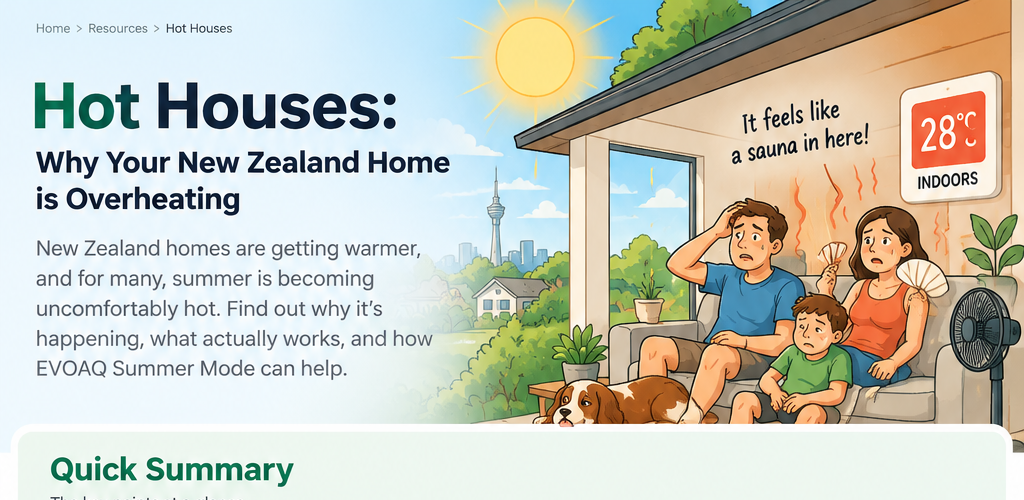
The hot-house problem is real
BRANZ's Household Energy End-use Project 2 (HEEP2) has provided some of the clearest evidence yet that summer overheating is a real issue in New Zealand homes.
In its summer 2023/24 research, 70% of households said their home was warmer than they would like at least some of the time. That was higher than the 48% who said their home was colder than they would like at least some time in winter.
The monitored temperature data is just as revealing. Of 111 monitored bedrooms in the preliminary summer analysis, 36% met the CIBSE 1b overheating criteria. In Auckland, 58% of the 45 monitored bedrooms met the same criteria.
BRANZ also found living-area temperatures averaging above 24°C in the evening, with around half of living areas above 25°C at 6pm. Bedrooms did not always recover overnight: a quarter of monitored bedrooms were still above 24°C at 2am.
These figures are preliminary research findings, but they point to a problem that is becoming increasingly difficult to ignore.
Read BRANZ's HEEP2 summer overheating findings.
Why are new homes becoming hot boxes?
Overheating rarely has a single cause. It is usually the result of several design decisions working together.
- Large areas of glazing can admit significant solar heat, particularly when windows are poorly shaded.
- Orientation matters. Windows exposed to strong afternoon sun can create substantial heat gain.
- External shading is often overlooked. Eaves, awnings and louvres can stop solar radiation before it reaches the glass.
- Airtight construction changes the way homes behave. Reducing uncontrolled air leakage is valuable for energy efficiency, but the home still needs a deliberate way to manage fresh air and heat.
- Townhouses and apartments can be difficult to cross-ventilate. With fewer external walls and fewer opportunities for opposing openings, natural airflow can be limited.
- Heat generated inside the home adds up. People, cooking, appliances, lighting and hot water all contribute heat.
The answer is not to blame insulation. Good insulation helps reduce unwanted heat transfer. The bigger question is what happens to the heat that does get into the building.
Ventilation helps — but it has a limit
This is where ventilation gets misunderstood.
If your home is 28°C and the outdoor air is 20°C, ventilation can be very useful. Bringing cooler outdoor air into the building while removing warmer indoor air can help lower the indoor temperature and, importantly, remove heat stored in the building.
But if the outdoor temperature is 30°C and your house is already 28°C, increasing ventilation is not going to make the house colder. You are simply replacing 28°C indoor air with 30°C outdoor air.
Ventilation can move heat out. It cannot create cold air.
This is why BRANZ distinguishes between ventilation and active cooling. Ventilation can be an important part of a passive cooling strategy, particularly when outdoor conditions are favourable, but it is not a replacement for active cooling when the outdoor temperature itself is too high.
The opportunity is often at night
One of the most useful times to ventilate for summer comfort is when the outside air becomes cooler than the air inside.
During a hot day, a house can absorb and store heat in floors, walls, ceilings, furniture and other internal surfaces. Simply waiting for the air temperature to fall is not enough — that stored heat can continue to warm the home well into the evening.
When cooler outdoor air becomes available, increased ventilation can help purge that accumulated heat.
That is particularly useful in homes where opening windows is impractical because of noise, security, privacy, weather or the design of the building.
New: EVOAQ Summer Mode
EVOAQ systems now include a Summer Mode designed to help purge hot air from the house.
Instead of treating ventilation as simply an on/off fresh-air function, Summer Mode gives the system a specific summer job: increase air movement to help remove accumulated heat from the home when conditions are suitable for heat purge.
This is particularly useful after a hot day, when the building itself can still be holding heat after the outdoor temperature starts to fall.
The aim isn't to turn a ventilation system into an air conditioner. It is to make better use of the cooling potential that already exists in the outdoor air.
Why not just open the windows?
Sometimes, opening windows is exactly the right answer. Cross-ventilation can be highly effective when a home has good airflow paths and the outdoor conditions are favourable.
But relying entirely on occupants to manage summer ventilation has limitations.
- Windows may need to stay closed because of traffic or neighbourhood noise.
- Security concerns can make overnight window opening undesirable.
- Privacy can be an issue, particularly in high-density housing.
- Some homes simply do not have good cross-ventilation paths.
- Occupants may not be home when the best opportunity for heat purge occurs.
- Opening windows at the wrong time can bring hotter outdoor air into the home.
Mechanical ventilation cannot solve every overheating problem, but it can provide a controlled way of moving air when natural ventilation is limited.
What actually works?
The best summer strategy is not one product. It is a combination of good building design, sensible occupant behaviour and systems that support the building rather than fight it.
1. Stop the heat getting in
External shading, sensible glazing, orientation and appropriate window design should be the first line of defence. It is much easier to prevent solar heat entering the house than to remove it later.
2. Move air when the conditions are right
Use cross-ventilation, stack ventilation or mechanical ventilation to take advantage of cooler outdoor conditions. The objective is to exchange warmer indoor air for cooler outdoor air — not simply to increase airflow for the sake of it.
3. Purge stored heat
After a hot day, the building can remain warm even after the sun has gone down. A dedicated summer purge strategy can help remove that accumulated heat and improve overnight comfort.
4. Use air movement for comfort
Ceiling fans and other air-moving fans can make people feel cooler by increasing air movement across the skin. They do not lower the air temperature, but they can improve perceived comfort.
5. Use active cooling when it is actually needed
When the outdoor air is too hot to provide useful cooling, a heat pump or other active cooling system may be required. That is not a failure of ventilation — it is simply the difference between ventilation and refrigeration-based cooling.
The smarter way to think about summer ventilation
The question shouldn't simply be “Is the house hot?”
A better question is:
“Can the outdoor air help make the house cooler?”
If the answer is yes, ventilation can be a powerful low-energy tool for removing heat. If the answer is no, more ventilation may not help and can sometimes make conditions worse.
That is why summer ventilation needs to be considered as part of the overall building design — alongside shading, glazing, orientation, insulation, thermal mass, air movement and active cooling.
The bottom line
New Zealand has a growing overheating problem. BRANZ's HEEP2 research shows that many homes are warmer than occupants would like, and a significant proportion of monitored bedrooms met recognised overheating criteria.
Ventilation is part of the solution, but it is not a magic cooling system. It works best when it takes advantage of cooler outdoor conditions and helps remove heat that has accumulated inside the building.
That is the purpose of EVOAQ Summer Mode: to help your home purge accumulated heat when outdoor conditions make that possible.
Because when the temperature outside finally drops, you want your house to take advantage of it.
Sources: BRANZ, The heat is on (HEEP2 summer comfort, cooling and indoor temperatures), updated 20 March 2025; BRANZ, SR502 HEEP2: Report on summer comfort, cooling and indoor temperatures. The BRANZ temperature findings cited above are preliminary monitoring results from the summer 2023/24 analysis.