Demand-Controlled Ventilation
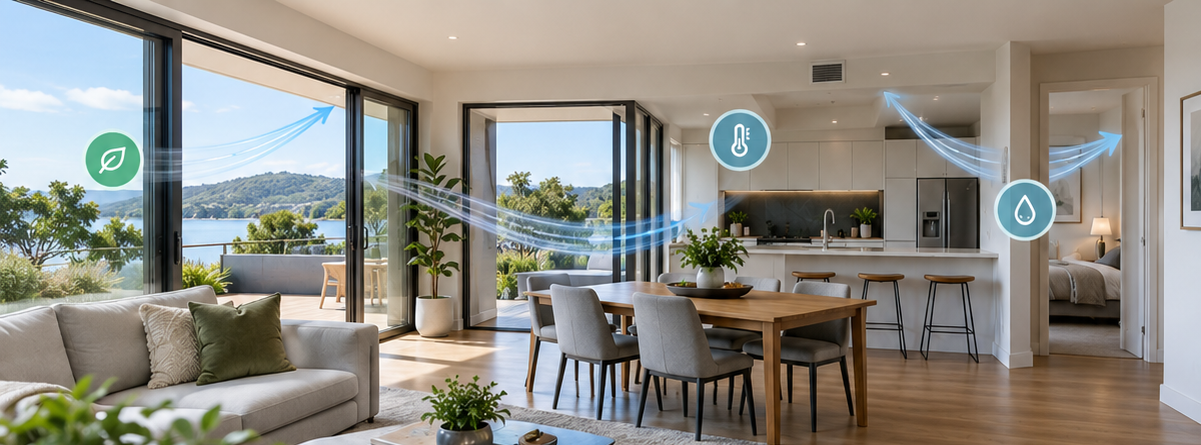
Ventilate according to what your home actually needs. EVOAQ combines intelligent sensing, smart control and efficient EC fans to adjust ventilation as conditions change.
Instead of treating ventilation as a fixed-speed appliance, the system can respond to measured conditions and adjust fan output to provide the right level of airflow.
Intelligent sensors
Monitor humidity, temperature and VOCs to understand changing indoor conditions.
Variable-speed EC fans
Adjust airflow smoothly instead of relying on simple on/off operation.
Automatic control
Use measured conditions to determine when more or less ventilation is needed.
What is demand-controlled ventilation?
Demand-controlled ventilation (DCV) adjusts ventilation output in response to measured conditions rather than relying on one fixed fan speed. The goal is simple: provide more ventilation when conditions call for it and less when they do not.
Fixed-speed ventilation
A conventional system may run at a predetermined rate regardless of whether the home currently needs more or less ventilation.
EVOAQ demand control
EVOAQ uses sensor information and intelligent control to adjust the fan output. That means the system can respond to changing air-quality and comfort conditions rather than simply running at one speed.
What does EVOAQ measure?
EVOAQ's intelligent ventilation approach uses sensor information to understand the conditions affecting indoor air quality and comfort. Current EVOAQ systems use humidity, temperature and VOC sensing, with the sensing location depending on the system design.
Humidity
Humidity changes can indicate moisture being generated by showers, cooking, drying and everyday occupancy.
VOC / air quality
VOC sensing helps identify changes in indoor air quality caused by everyday pollutants, odours and household activities.
Temperature
Temperature information helps the system consider comfort and the conditions of the air being supplied.
How intelligent ventilation works
The technology is best understood as a simple cycle: sense the conditions, decide what ventilation is appropriate, then adjust the fan.
Sense
Sensors monitor relevant air-quality and comfort conditions.
Analyse
The controller interprets the available information and determines the required ventilation response.
Respond
The intelligent EC fan adjusts its speed to deliver the required airflow.
Continue
The system keeps responding as conditions change, rather than relying on a single fixed setting.
Why the intelligent fan matters
Sensors are only useful when the fan can respond to what they detect. EVOAQ combines demand control with electronically commutated (EC) fans capable of variable-speed operation.
Right airflow
The fan can increase or reduce airflow rather than being limited to simple on/off operation.
Efficient operation
EC motor technology allows efficient operation across a wide range of fan speeds.
Continuous ventilation
EVOAQ's approach allows very low airflow when conditions require it, rather than treating ventilation as an all-or-nothing decision.
What happens in a real home?
A home's ventilation needs are not constant. They change with occupancy, showers, cooking, weather and other everyday activities.
| Situation | What can change | DCV response |
|---|---|---|
| Morning routine | People wake, shower and begin using the home. | Changing humidity and air-quality conditions can influence ventilation demand. |
| Cooking | Moisture, odours and pollutants can rise quickly. | Higher demand can call for increased ventilation, depending on the system and sensor location. |
| Quiet daytime | The home may be lightly occupied. | There may be less need for high airflow, allowing the system to operate at a lower rate. |
| Changing outdoor conditions | The temperature and quality of available incoming air can change. | EVOAQ systems also consider the quality of available supply air as part of their control strategy. |
Demand control is more than “smart” marketing
The useful question is not whether a ventilation system is called smart. It is whether the system can measure meaningful conditions, make a sensible control decision and physically change its airflow in response.
Measure
Use meaningful sensor information rather than guessing what the home needs.
Control
Use software and control logic to translate those measurements into a ventilation response.
Deliver
Use a variable-speed fan capable of actually delivering the required airflow.
Frequently asked questions
What is demand-controlled ventilation?
It is a ventilation strategy that adjusts airflow according to measured conditions rather than operating at one fixed rate all the time.
What sensors does EVOAQ use?
EVOAQ ventilation systems use humidity, temperature and VOC sensing as part of their intelligent control approach. Sensor configuration varies by product and system design.
Does DCV mean the ventilation turns off?
Not necessarily. EVOAQ's continuous ventilation approach combines demand control with efficient EC fans so airflow can be reduced to a very low level when appropriate rather than relying on simple on/off operation.
Why use EC fans?
EC motors are well suited to variable-speed ventilation because they can operate efficiently across a broad range of speeds, allowing the fan output to respond to changing demand.
Is demand-controlled ventilation the same as heat recovery?
No. Demand control describes how ventilation output is controlled. Heat recovery is a separate technology involving heat exchange between outgoing and incoming air.
A smarter way to ventilate
EVOAQ combines sensing, intelligent control and efficient EC fan technology to make ventilation more responsive to the conditions in and around your home.
Explore EVOAQ Ventilation Systems